
The roundups name brands; the records name builders
Every AR shopping roundup lists the same famous apps. Almost none of them answer the buyer's actual question: if we wanted this, who would build it? Our database of 68 brand AR deployments records the implementation vendor wherever it is public, and 55 of the 68 name one. The answer splits three ways: build it in-house, hire a specialist vendor, or build on a platform like Snap's Camera Kit.
In-house is the biggest single route
Twelve of the 55 named implementations were built in-house, more than any vendor's count. These are the brands with platform teams: the car makers with their own configurator engines and the retail giants with labs. The in-house route concentrates in automotive and big retail, where the 3D pipeline feeds more than one campaign and the asset library justifies permanent staff.
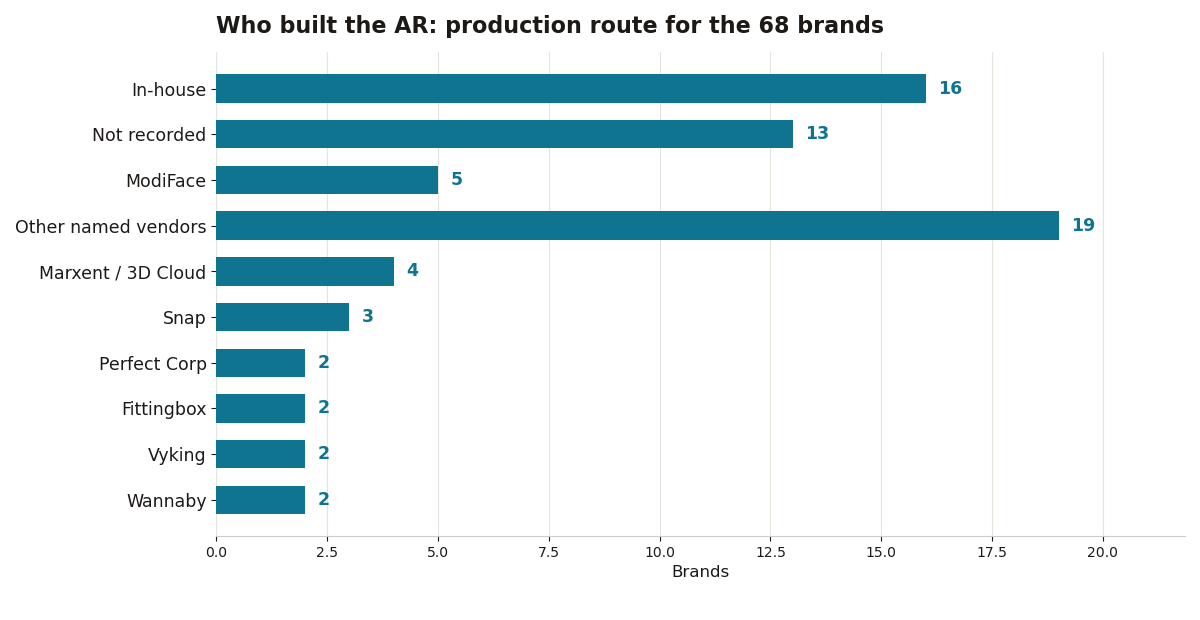
The vendor field, counted
Among named vendors, ModiFace leads with 5 brands, all in beauty, which is why beauty try-on feels standardized: it largely is, running on a small number of engines. Snap's Camera Kit powers 3 of the records as a platform rather than an agency. Perfect Corp, Vyking, Wannaby and 3D Cloud by Marxent carry 2 each, and the long tail is one brand per vendor: Accenture, ZeroLight, 8th Wall and others. Thirteen records name no vendor at all, which usually means the deployment was announced as a brand story and the builder stayed off stage.
What this means for a brand choosing a route
Below a certain catalog size, the vendor route wins on arithmetic: the engine, the tracking and the device testing already exist. The in-house route wins when the 3D assets themselves become the asset, reused across seasons and channels. The directory records the vendor on each brand's page precisely so this decision can start from evidence about who built what, instead of from a pitch deck.